
 Emissions calculator


Nitrogen plays an important role in pasture and crop production, but not all of it ends up where you want it. Better nutrient management can help improve efficiency, reduce losses and support productive farm systems, while also helping to lower nitrous oxide emissions.
Watch this video: where nitrous oxide comes from
Actions to reduce nitrous oxide
-
Stocking rate and performance
Small changes to stocking rates, feed use and animal performance can improve efficiency while maintaining productivity. On some farms, fine-tuning the farm system can reduce greenhouse gas emissions by up to 10%.
-
Efficiency improvements
Efficient farm systems often produce fewer emissions per unit of product. There is no one-size-fits-all approach, but improving resource use can support productivity and long-term resilience.
-
Nitrogen fertiliser
For some farms, reducing nitrogen use or applying it more strategically can lower nitrous oxide emissions and reduce costs without significantly affecting production. The right approach will depend on your soils, climate and farm system.
-
Once-a-day milking
For some farms, once-a-day milking can help lower operating costs while reducing emissions. Results will depend on factors such as production levels, labour savings and how it fits within the wider farm system.
-
Low-emission feeds
Research is showing that feed choices may help reduce emissions while still supporting good production and animal performance. What works will depend on your farm system, feed availability and economics.
-
Potential actions
Explore emerging options and future technologies currently being researched. These approaches are showing promise, but more evidence is needed before they are recognised in New Zealand's national greenhouse gas inventory.
How does nitrous oxide contribute to climate change?
Nitrous oxide is a greenhouse gas produced naturally in soils when nitrogen from fertiliser, effluent and animal urine is processed by soil microbes.
Like carbon dioxide, nitrous oxide stays in the atmosphere for a long time. Each emission remains in the atmosphere for more than 100 years, contributing to warming long after it is released.
Nitrous oxide makes up around 20% of New Zealand's agricultural greenhouse gas emissions. Most of these emissions come from livestock urine deposited onto soils, with nitrogen fertiliser also contributing.
New Zealand's emissions of nitrous oxide have risen by about 50% since 1990—mostly as a result of the expansion of the dairy sector and increased use of nitrogen-based fertilisers.
Under the Climate Change Response (Zero Carbon) Amendment Act, the Government has set a target to reduce long-lived greenhouse gas emissions (carbon dioxide and nitrous oxide) to net zero (that is, emissions are matched by removals) by 2050.
Where does nitrous oxide come from?
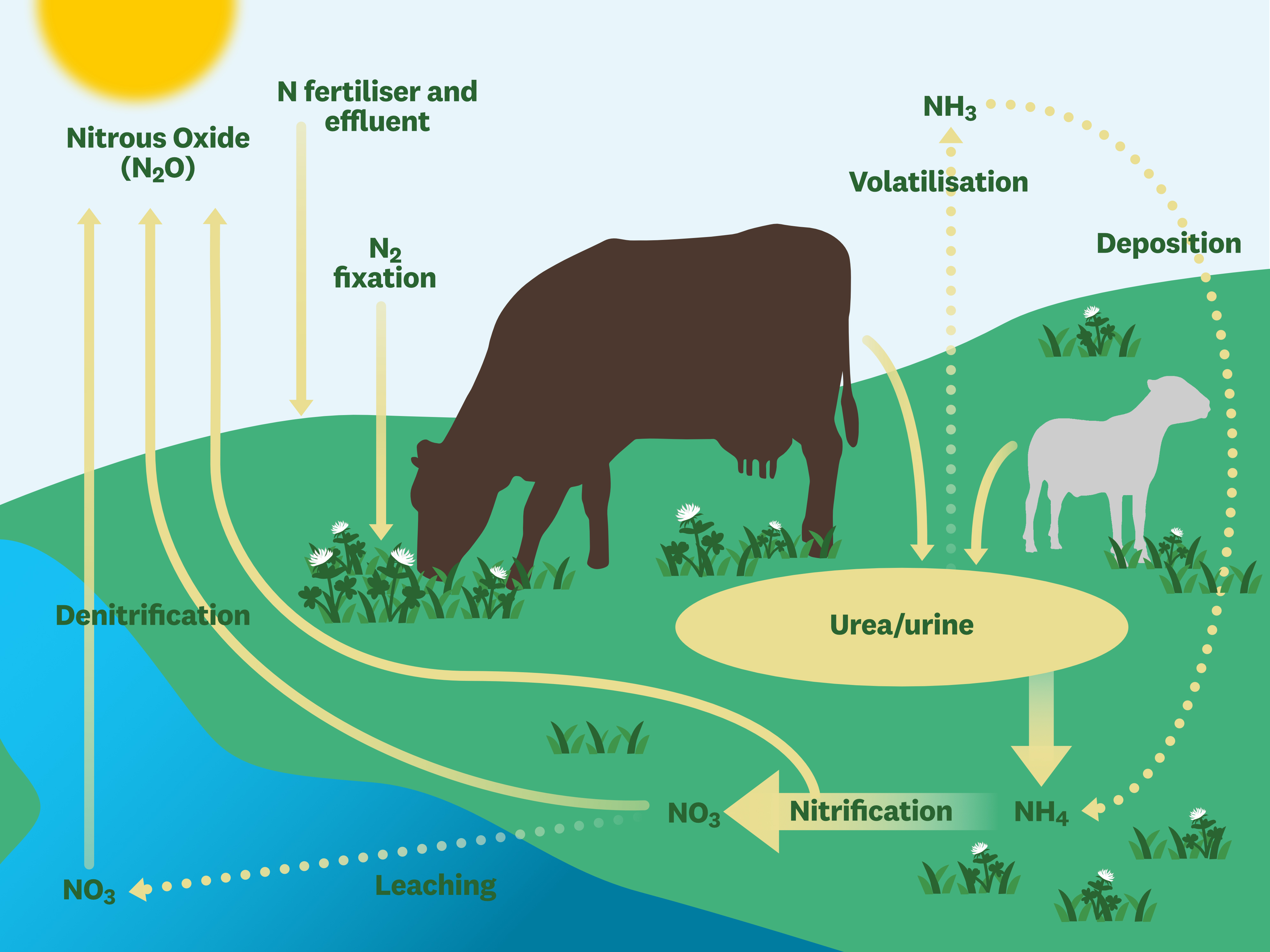
Nitrous oxide is produced naturally in soils as part of the nitrogen cycle.
Nitrogen enters the soil from a range of sources, including animal urine and dung, nitrogen fertiliser, effluent and legumes. Soil microbes then break down and transform this nitrogen into different forms that can be used by plants.
On livestock farms, animal urine is typically the largest source of nitrogen entering the soil. When grazing animals consume nitrogen in pasture and crops, much of it is returned to the soil in urine and dung. These deposits create concentrated patches of nitrogen that are processed by soil microbes.
As nitrogen moves through the soil, a small proportion is released as nitrous oxide. Some nitrogen may also move beyond the root zone and leach into waterways through drainage and runoff.
The diagram below shows how nitrogen moves through the soil and the pathways that can lead to nitrous oxide being produced.
What can farmers do to reduce nitrous oxide emissions?
There is no single solution that will reduce nitrous oxide emissions on every farm. However, many of the actions that improve nitrogen use efficiency can also help reduce nitrous oxide emissions.
In simple terms, reducing nitrous oxide comes down to reducing excess nitrogen in the farming system and making sure more of it is used for productive plant growth.
On-farm proof:
Dion Gordon reduced nitrous oxide emissions by lowering nitrogen fertiliser use, reducing stocking rates and improving overall farm efficiency. Small changes across the system helped reduce nitrogen losses while maintaining profitability.
"The key is making sure most of the nitrogen is used for plant growth." Dr Cécile de Klein
Considerable research is under way in New Zealand and overseas to identify and verify new approaches to reducing on-farm emissions of nitrous oxide. While none of these options is fully proven yet, a number are showing promise. You can find information on these approaches on the future actions page.
Will initiatives to reduce nitrate leaching also reduce nitrous oxide emissions?
Leaching arises when there’s excess nitrogen in the soil. Nitrous oxide arises from nitrogen transformations in the soil: the more nitrogen there is, the more nitrous oxide is produced. Therefore, efforts to reduce the amount of nitrogen in the soil will reduce both leaching and nitrous oxide emissions.
Scientists are looking closely at practices they know will help reduce nitrate leaching to see how they affect nitrous oxide emissions. For example, they’re investigating if farmers can use catch crops such as oats to reduce excess nitrate in the soil at the end of winter, and how they can best schedule irrigation and fertiliser applications to minimise the risk of nitrogen loss via nitrate leaching and nitrous oxide emissions.
At Silverton Pastoral, the Abbiss family use precision agriculture technology and targeted fertiliser applications to match inputs to crop requirements, helping improve nutrient efficiency across the farm.
Real-farm stories: What’s working on-farm
-

Building resilience in a changing environment
Emma Crutchley's family have been farming on Puketoi Station in the Māniatoto since 1939. They've had to adapt to many issues outside of their control over this time. Keeping a positive mindset is helping them get their heads around the latest challenge - greenhouse gas emissions and climate change.
-
Four small changes across the system. Big gains over time.
Kaiwaiwai Dairies comprises a 337-hectare milking platform, plus a 305-hectare dairy support block located in South Wairarapa, between Featherston and Martinborough.
-

Efficient farming for future sustainability
An emphasis on efficiency improvements and soil health are helping keep greenhouse gas emissions down on Hugh Ritchie's complex arable, livestock and horticulture operation in Hawke's Bay.
Other helpful resources
For more on the sources and science of nitrous oxide, see:
Take the next step
Lots of small steps can add up to make a big difference.
-
Understand your emissions profile
-
Explore what’s working on-farm
-
See practical actions farmers are taking now