
 Emissions calculator


Soil health and innovation focus help reduce emissions
Four generations of the Abbiss family have placed the environment at the heart of farming the heavy soils at Silverton Pastoral. Supporting soil health and using the latest technology is helping them reduce GHG emissions too.
On-farm successes
• Direct drilling improved soil structure
• Using technology to farm efficiently
• Finishing livestock faster to higher weights
• Improved feed efficiency
Watch this story
"Farming is all about understanding how to bring the best out of a biological system, while respecting its capacity and natural limits."
Mike Abbiss
About Silverton Pastoral
Four generations of the Abbiss family have placed the environment at the heart of farming the heavy soils at Silverton Pastoral. Supporting soil health and respecting the land’s natural limits has also helped reduce emissions.
Silverton Pastoral is a fourth-generation family farm located 15 minutes out of Feilding in the Manawatu. The mixed pastoral and arable operation is run by James Abbiss, along with his brothers Hugh and Tim and his father Mike. James’ grandfather Bill and his father before him also farmed the land.
Silverton Pastoral spans two blocks. The original, ‘home’ block is in Halcombe and is just over 800ha of rolling country. More recently, the family has also purchased a 180ha mixed cropping block in Cheltenham.
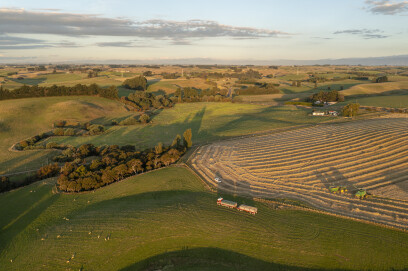
Silverton Pastoral - the Abbiss' farm near Halcombe (Photo: Dave Allen Photography)
Currently, the system is mostly lamb trading and finishing (around 60-70%) through autumn and winter, with a crop rotation built into the system running in conjunction with the livestock.
The cropping component (30-40%) includes a rotation of wheat, barley, and summer forage crops such as chicory and brassicas (rape and turnips), before heading back into short-term pasture. Legume crops such as peas are also grown.
The farm is predominantly clay-based soil and receives around 950-1,000mm rainfall annually. This can be challenging on their heavy soils and requires a proactive approach – working with the conditions to bring out the best in the farm. The window for establishing crops or for grazing pastures effectively can often be very limited, which requires a great deal of attention in order to manage effectively.
The Abbiss’ have integrated livestock with their cropping programme since the early 1980s. Since then, system changes have been made such phasing out bull-beef farming in 2016 due to the impact it was having on soil compaction and structure, and pasture damage.
The Abbiss' run a six-year pasture-based rotation that is focused on driving a high legume content in the sward – 3.5 years of that is in a hybrid ryegrass mix with clovers and herbs. Brassicas and herbs such as chicory are then used as a break crop in the rotation. They are also used as a livestock forage component, which feeds the cash cropping system at strategic times. Cereals are integrated afterwards to utilise any excess nutrients and tidy up and avoid weed pressure.
The development of this rotational approach was underpinned by the Abbiss’ deep understanding of their soils' limitations, the contour of the land and how previous farm systems have responded to the environment.
The challenge
The Abbiss family’s Manawatu farm has heavy clay soils and a generous rainfall each year and often there’s just a small window of opportunity to establish crops. They’ve found that healthy soil structure is the key to growing healthy crops and lambs.
The results
On-farm progress
• Direct drilling improves soil structure and increases efficiency
• Technology use includes GPS, Precision Ag and fertiliser/chemical traceability
• Stopped stocking bulls because of soil compaction and pasture damage
• Running a 6-year pasture-based rotation
The Abbiss’ place the environment at the heart of how they farm. “The health of the environment goes hand in hand with the business side of things”, says James. “You can’t have one without the other.”
They have been working with the regional council to develop a large wetland on the farm and to plant up their waterways.
OverseerFM and Farm Environment Plans have been completed for both properties to analyse nutrient risks and losses for the properties in line with regional and national legislation.
Direct drilling has been implemented since the early 2000s, aiming to keep the soil profile intact and minimise disturbance – critical on their class of country where the soils are heavier and easily affected.
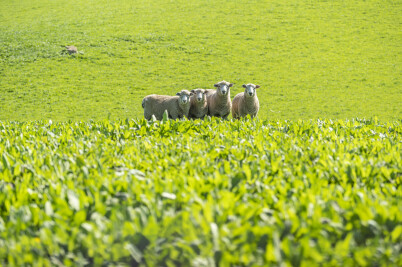
Lambs grazing on chicory at the Abbiss' (Photo: Dave Allen Photography)
The Abbiss' also employ precision agricultural technologies to help ensure inputs are minimised, including potential yield mapping, GPS systems and regular soil testing. All of this, coupled with direct drilling, has enabled efficiency gains to be made and to ensure consistency.
“Farming is all about understanding how to bring the best out of a biological system, while respecting its capacity and natural limits,” says James’ dad Mike.
Their operation has some complex challenges, but by maintaining a flexible and proactive approach they’ve been able to stay ahead of the game.
More recently, the Abbiss’ have become aware of the impact of farming on the climate and are starting to get their heads around what their greenhouse gas emissions are and how they might be reduced. They are currently running several scenario analyses through OverseerFM to understand the drivers of their emissions and where there may be options for reductions.
The table below shows how the numbers looked for the Abbiss’ 800ha home block in 2020.
| 2020 | |
| Effective area (ha) | 779 |
| Total methane per hectare (tonnes CO2-e) | 2.0 |
| Total nitrous oxide per hectare (tonnes CO2-e) | 0.9 |
| Total biological GHGs from effective area per hectare (tonnes CO2-e/ha) | 2.9 |
| Total methane (kg)* | 62,406 |
| N leaching (kg/N/ha/yr) | 25 |
*The weight of methane is shown here without conversion to carbon dioxide equivalence (CO2-e) because this is how it will be reported in any farm-level pricing mechanism.
The main drivers of agricultural greenhouse gas emissions (methane and nitrous oxide) are:
- Amount of dry matter eaten
- Protein level of the diet
- Amount of nitrogen fertiliser applied
For the Abbiss', their emissions are driven by the sheep they run and the nitrogen fertiliser they apply at strategic times of the year.
A number of tools are available for farmers to find out their greenhouse gas numbers. The Abbiss’ have used OverseerFM to work out what theirs are. You can read about this and other tools on our Know Your Numbers page.
What changed on-farm
The Abbiss’ are already doing a lot for the environment, in particular to support healthy soil structures and microbes and to improve the productivity of their crops and livestock.
Many of these actions also have a positive impact in terms of greenhouse gas emissions, including:
- Reducing nitrogen fertiliser use, via:
- Matching inputs to crop requirements
- Precision agriculture technology including GPS mapping and regular soil testing so that fertiliser is only applied where and when it is needed
- Integrating livestock with the crops to encourage nutrient cycling and help get crop residue back into the ground
- Finishing livestock faster and to higher weights
- Improved feed efficiency
Next steps
Explore practical actions farmers are trialling on farm.
Farming for resilience in the face of change
James and Mike agree that the pace of change is increasing for farmers at the moment and that climate change is adding to this. They are philosophical though, “agriculture in New Zealand has always been reinventing itself and evolving, and greenhouse gas emissions are the latest extension of this,” says Mike.
The Abbiss’ are optimistic about the future. The diversified system they’ve developed and their core focus on the environment has set up them up well to respond to the new challenge of reducing their emissions.
“Biology and the financial farm system go hand in hand. You can't have one without the other working.”
James Abbiss