
 Emissions calculator


Building resilience in a changing environment
For Emma and Kyle at Puketoi Station in Central Otago, adapting to climate change is less about chasing perfection and more about making practical changes that lighten their impact and future-proof the farm
"As farmers we have no control over the cards we are dealt, but we can decide how we play them. How we play those cards is the exciting bit."
Emma Crutchley
On-farm successes
• Reduced nutrient losses
• 10% reduction in nitrous oxide emissions
• Total methane emissions down by 4%
• Increased flexibility and resilience in the system
• Easier to maintain ewe condition all year round
Watch this story
About Puketoi
Emma Crutchley and her husband Kyle Hagen farm Puketoi Station - a 2,885ha (2,737ha effective) sheep and beef farm in the Māniatoto, Central Otago. It has been in the Crutchley family since Emma's great-grandfather bought it in 1939.
Of the effective area, 1,300ha is hill/high country and 1,437ha flat, including 475ha of irrigated land. Emma and Kyle run approximately 6,500 romney crossbred ewes and an Angus beef stud. The irrigated land is used for lamb finishing and arable cropping.
The table below shows Puketoi Station's physical parameters.
| 2019 | 2022 | 2023 | |
| Effective ha | 2,797 | 2,737 | 2,737 |
| Breeding ewes | 7,100 | 6,590 | 6,601 |
| Breeding cows | 160 | 163 | 145 |
| Total Stock Units | 15,919 | 13,860 | 14,877 |
| SU/ha | 5.4 | 5.1 | 5.5 |
| Arable crop (ha) | 32 | 40 | 59 |
The challenge
Puketoi Station receives very low annual rainfall - just 350mm - and has experienced some very severe droughts over the years, along with long, cold winters. Emma says they're at the mercy of Mother Nature so their farming system must be closely intertwined with the environment.
The results
On-farm progress
• 10% reduction in nitrous oxide emissions
• Total methane emissions down by 4%
• Introduced arable cropping
• Planted riparian strips and regenerated wetland
• Converted dyke irrigation to centre pivot for more efficient water use
Since 2009, Emma and Kyle have become increasingly aware of the attention on agriculture's contribution to climate change. Emma attended a greenhouse gas course through Massey University in 2019, which helped her understand the main sources of emissions at Puketoi.
The farm team has always had a focus on per animal production, rather than driving for more animals to derive output. With Emma's new knowledge in hand, they set out to alter the system to reduce emissions while retaining profitability and meeting broader family goals for the environment.
The table below shows Puketoi's greenhouse gas numbers since 2019:
| 2019 | 2022 | 2023 | % change 2023 v 2019 | |
| Methane (total T CO2e) | 4,114 | 3,652 | 3,944 | -4% |
| Methane (T CH4)* | 165 | 146 | 158 | -4% |
| Nitrous oxide (total T CO2e) | 909 | 630 | 814 | -10% |
| Total tonnes CO2e** | 5,487 | 5,131 | 5,444 | -1% |
| Total tonnes CO2e**/ha | 1.90 | 1.78 | 1.89 | -1% |
*The weight of methane is shown here without conversion to carbon dioxide equivalence (CO2-e) because this is how it will be reported in the farm-level pricing mechanism.
**Includes CO2 emissions from fertiliser, noting that these will not be included in the farm-level pricing mechanism.
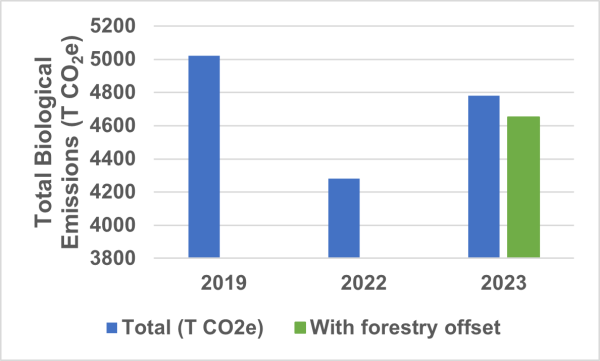
Puketoi total biological emissions (methane and nitrous oxide) since 2019
As shown in the table and the graph above, there has been a decrease in total emissions and nitrous oxide emissions since 2019 and a very small reduction in methane (albeit an increase between 2022 and 2023 due to an increase in stock numbers - less capital stock was offset by more trade lambs).
Emma and Kyle use OverseerFM for their farm’s greenhouse gas numbers. To find out more about this tool and others, see our Know Your Numbers page.
What changed on-farm
Emma and Kyle made three main changes on Puketoi that has helped reduce their emissions:
- Decreased winter crop area by 28.8% from 184ha to 131ha and a reduction in Nitrogen applied to crops from 59kgN/ha to 27kgN/ha – decreased nitrous oxide emissions.
- Decreased total stock units by 1.5% from 15,191 to 14,962 and increased total liveweight sold (kg/ha grazed) – decreased methane emissions.
- Decreased total beef RSU by 17% - decreased methane emissions.
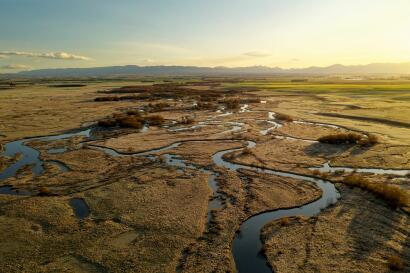
Upper Taieri Scroll Plain and wetland complex (Photo: Dave Allen Photography)
In addition, some land was taken out of production in order to plant up riparian strips and regenerate a wetland. In many respects, the efficiency of the farm system has improved, resulting in a reduction in greenhouse gas emissions, while maintaining the financial sustainability of the business.
Emma and Kyle’s initial focus was on building more resilience into their farm system, reducing stocking areas knowing they could get better performance with less stock. This was based on multi-generational knowledge and incorporating that into the farm system.
The shift to arable over the years also aligned with the resources they had and market demand. Careful consideration was given to appropriate crops as many are not suited to the extreme climate at Puketoi.
Cropping was also introduced gradually to ensure there was a market for what they were producing. They have converted most of their border dyke irrigation to centre pivot. This was primarily done for water use efficiency and water quality management, but also supported wider changes to the farm system.
Next steps
Explore practical actions farmers are trialling on farm.
Impact of the changes
The changes that Emma and Kyle have been making are not just helping the climate. They report that it is easier now to maintain ewes in good condition all year round. In addition, creating flexibility reduces pressure on the family business (financial performance has stayed relatively similar in real terms).
They have been striving for improved lambing percentage, but various disruptions (beyond their control) since 2019 have hampered this. They are confident this improvement will still come.
The overall environmental footprint has always been a focus, but lowering greenhouse gas emissions has also reduced nutrient losses. It has also provided greater resilience to market changes as a result of increased flexibility in the system. It has enabled them to focus on resilience for the business in relation to water, biodiversity, adaptation to climate change, climate change policy and labour as well as animal welfare. The changes have also enabled retirement of lesser productive areas, much of which they are planting with trees (exotic and native).
Future changes
Emma and Kyle are keen to move to more arable. To do this, they would need to know there were markets at the end of it and would also need to have processes in place to manage climate risk to be able to make that shift confidently.
Stock numbers are “about right" for now; the continued effort in the system will be in driving per animal performance. They would look to reduce stock numbers further if that supported reduced emissions and retained profitability. Low methane genetics will also be explored for the maternal flock.
The timing of sale of trade lambs has an influence on emissions (lambs held longer increase emissions). The trade lamb policy could be adapted to reduce emissions further.
Emma and Kyle are also interested in being part of the solution to support greater resilience and sustainability in the local food network. They are members of their local catchment group working to be part of collective solutions to tackling challenges like climate change and local food networks.
Farming for resilience
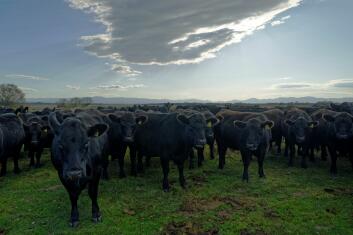
Angus beef cows at Puketoi Station. (Photo: Dave Allen Photography)
Long-term resilience to climate changes and lowering greenhouse gases are front of mind for Emma and Kyle, especially given Puketoi’s extreme environment. Actions helping build resilience include:
- Use a terminal sire over 40% of their ewes to provide flexibility with lamb sales.
- Running beef cows across all land types (including irrigated) as a tool for managing feed quality.
- Integrating wide shelter belts (which are in the ETS).
- Retiring riparian areas and planting with natives.
- Producing much of their own seed on-farm (clover, ryegrass and lucerne).
- Direct-drill except when incorporating straw.
- Spray-irrigating 95% of the farms irrigated area (more efficient water use than previous border-dyke).
Lessons for other farmers
“Instead of being a perfectionist, think 'I'll set my goal at an achievable level and have a go.' And if you fail, make a list of the things you learned and do it differently next time.”
Emma Crutchley
Below are some suggestions from Emma and Kyle to help other farmers get their heads around the opportunities and challenges in reducing agricultural greenhouse gas emissions and adapting to a changing climate:
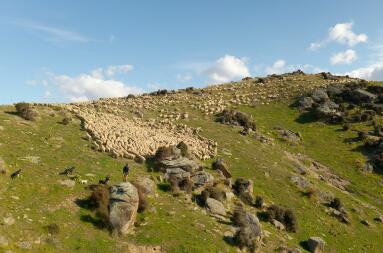
Mustering at Puketoi Station (Photo: Dave Allen Photography)
- It is important to know what problem you are trying to fix and know what the options are to do it. Often the solution to the problem is counter-intuitive to what you think. For example, reducing stocking rate may seem counter-productive, but with increased per animal performance you can be better off. Similarly farming to the carrying capacity of the land rather than chasing a particular policy.
- Be aware that as per head production increases, emissions may also increase so there is a need for constant adjustment.
- Modelling options can help de-risk making changes and give you confidence to make them.
- Important to reflect on what you’ve got and be grateful for that. That helps with a mindset of supporting and nurturing what you have.
- Consider everything through a lens of opportunity, rather than a challenge or a threat.
- Think across the multiple challenges that are being faced regardless of policy incentives its important to focus on solutions that can tick off multiple challenges. For example, shelter is also sequestration, or riparian quality can support water quality and biodiversity outcomes.
What actions could work on your farm?
Many of the changes made at Puketoi Station are actions other farmers are already exploring around New Zealand. Discover what could work on your farm:
Download this story
Download a copy of Emma and Kyle's story here [PDF, 673 KB] .