
 Emissions calculator


Efficient farming for future sustainability
Hugh Ritchie’s making improvements to efficiency and soil health to keep greenhouse gas emissions down on his Hawke’s Bay farm. Learning from others and trying new ideas is a big part of Hugh’s approach.
On-farm successes:
• Reduced nitrogen fertiliser use
• Finishing livestock faster and to higher weights
• Improved feed and water efficiency
• Active in industry organisations and regional councils
"It's easy to feel overwhelmed. Break it down into manageable chunks. Focus on one part of your business, make some gains there and move onto the next part."
Hugh Ritchie
Watch this story
About Drumpeel Farms
Hugh and Sharon Ritchie own Drumpeel Farms – a mixed cropping and drystock operation that spans two separate blocks in central Hawke’s Bay, totalling just over 2,000 ha. The farm has been in the family since the early 1960s.
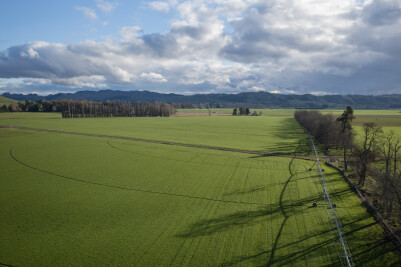
Drumpeel Farms, Hawke's Bay (Photo credit: Dave Allen Photography)
The main cropping area is the Drumpeel block – 640 hectares of flat country near Ōtane comprising peat, silt and sandy soils. Hugh grows a variety of crops on this block – wheat, maize, barley, oats, carrots, peas, sweetcorn, beans, export squash – and some specialist grass and vegetable seed production. Around 7,000-10,000 lambs are finished on the cropping area each winter, grazing Italian short-rotation grasses that are sown over the top of the old crops.
The area is summer dry and gets around 800-850mm average annual rainfall – although the distribution of this throughout the year is changing. Irrigation was introduced in the mid-1990s, supplied from an on-site bore.
The Ritchies also farm a 1,200ha pastoral block at Horonui, closer to Hastings. This is medium to steep rolling hill country, which supports a 1,500-strong bull beef finishing unit, a small cropping area on the flats and more lamb finishing.
The challenge
Drumpeel is a complex operation, combining arable paddocks with livestock and horticulture in a dry Hawkes Bay climate. Restoring soil structure and health damaged through over-tilling the soil in the past has been a major focus in recent years.
Hugh says that managing a biological system is hard and people don’t fully understand the complexities of what farmers are being asked to do to reduce their emissions.
The results
On-farm progress
• Well-structured soil efficiently captures and holds rainwater
• Extensive monitoring to track and predict each crop's water needs
• Livestock finish faster and to higher weights
• Varied farm operations work efficiently as a whole
Hugh is starting to get his head around what his numbers are, what drives emissions in his farm system, what he might be able to do to reduce them and the trade-offs.
| Drumpeel Block | 2019 |
| Effective area (ha) | 585.6 |
| Total methane (tonnes CO2-e) | 4.1 |
| Total nitrous oxide (tonnes CO2-e) | 1.3 |
| Total biological GHGs from effective area per hectare (tonnes CO2-e/ha) | 5.4 |
| Total methane for Drumpeel Block (kg)* | 96,038 |
| Total methane per hectare (kg/ha) | 164 |
| Horonui Block | |
| Effective area (ha) | 1,100 |
| Total methane (tonnes CO2-e) | 3.1 |
| Total nitrous oxide (tonnes CO2-e) | 1.1 |
| Total biological GHGs from effective area per hectare (tonnes CO2-e/ha) | 4.2 |
| Total methane for Horonui Block (kg)* | 136,400 |
| Total methane per hectare (kg/ha) | 124 |
| Total for farm | |
| Total biological GHGs from effective area for both blocks (tonnes CO2-e) | 7,775 |
| Average tonnes CO2-e per effective hectare across both blocks | 4.6 |
| Total methane for both blocks (kg)* | 232,438 |
*The weight of methane is shown here without conversion to CO2-e because this is how it would be required to be reported in any farm-level pricing mechanism.
The main drivers of agricultural greenhouse gas emissions (methane and nitrous oxide) are:
- Amount of dry matter eaten
- Protein level of the diet
- Amount of nitrogen fertiliser applied
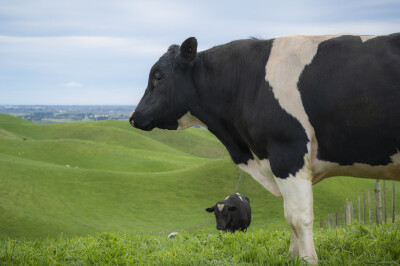
Bulls on Hugh Ritchie's Horonui Block, Hawke's Bay (Photo credit: Dave Allen Photography)
For Hugh, his emissions are driven by the sheep and cattle he farms and the nitrogen fertiliser he applies. Now that he has his numbers together, he is well placed to start developing a plan to manage them.
Because of the complexity of Hugh’s system, he used a combination of OverseerFM and Beef + Lamb New Zealand’s greenhouse gas calculator. You can read about these and other tools on our Know your numbers page.
What changed on-farm
Hugh is already doing a lot for the environment, in particular to support healthy soil structures and microbes and to improve the productivity of his crops and livestock.
Many of these actions also have a positive impact in terms of greenhouse gas emissions, including:
- Reducing nitrogen fertiliser use via:
- Crop rotation, e.g. following legume crops with wheat
- Avoiding soil compaction
- Precision agriculture technology
- Integrating livestock with the crops to encourage nutrient cycling and help get crop residue back into the ground
- Variable rate irrigation to optimise pasture and crop growth and avoid nutrient runoff
- Finishing livestock faster and to higher weights
- Culling less productive stock
- Improved feed efficiency
Next steps
Explore practical actions farmers are trialling on farm.
What led to the changes?
Hugh has long been focused on the environment – seeing its health, particularly the soil, as integral to the success of his farming business. He takes great care to look after this vital resource, minimising damage from tillage, avoiding soil compaction, using variable rate irrigation and precision agriculture technologies, and integrating livestock.
Although he is worried about the increasing pressure on farmers in terms of regulation, he is pragmatic that they have to get on with it.
“To do nothing is not an option,” says Hugh. “It’s easy to feel overwhelmed, but you don’t eat an elephant in one go. You have to break it down into manageable chunks. Focus on one part of your business, make some gains there and move onto the next part.”
For Hugh, this has been about efficiency – getting the different components of his complex enterprise working productively as possible, all the while staying within the natural limits of the environment and minimising inputs such as fertiliser.
It is also about being flexible and staying connected with others. Hugh values his involvement in local farming groups, with industry organisations and others like the regional council – seeing these as important sources of information and places to test his thinking and hear what others are doing.
“Being willing to try new ideas and to learn from others has been key in us getting to where we are now,” he says. “Managing a biological system is hard, and farming is only going to get more complex and technical. Working alongside others can make it feel less daunting.”
Farming for resilience
As well as starting to address his greenhouse gas emissions, Hugh is aware of the need to adapt to a changing climate.
The East Coast of the North Island is expected to warm by about 1°C by mid-century and more than 2°C by late century. Scenarios suggest that there will be an increase in very dry conditions and more hot days (over 25°C), with some seasonal reduction in rainfall in winter and spring. There are likely to be fewer frosts and an increase in extreme wind speeds and intensity of ex-tropical cyclones.
Availability of water is already an issue for arable and vegetable cropping in the area – something Hugh knows will continue to worsen in the future. He has optimised his irrigation technology to achieve efficient water use and focuses carefully on management and scheduling. Extensive use of soil moisture monitoring services allows Hugh to track and predict crop water status accurately. This gives him the confidence to avoid unnecessary irrigation while obtaining maximum yields. Careful crop rotation design and selecting crops with different planting and maturity dates reduces competition for limited irrigation capacity.
Healthy, well-structured soil has higher infiltration capacity, better internal drainage and minimum limitations to root growth. Hugh’s focus on maintaining healthy soils is key in capturing the limited summer rains. This helps his farm cope with extreme rain events when they do happen.
Lessons for other farmers
“If you focus on efficiency then you're probably going a long way to making gains around what your carbon losses are.”
Hugh Ritchie
What actions could work on your farm?
Many of the changes made at Drumpeel Farms are actions other farmers are already exploring around New Zealand. Discover what could work on your farm: