
 Emissions calculator


A flexible farm is a more resilient farm
Developing a flexible farming system has helped Kereru Station become more robust, better able to manage droughts and climate change, and continue delivering reliable returns.
On-farm successes
• 17% reduction in total biological GHG emissions (2010-2022)
• Reliable profitablity
• Increased meat and wool production per hectare
Watch this story
"Changing to a flexible farming system enables it to be more robust, to manage through droughts and climatic change."
About Kereru Station
The property is split into two blocks, a finishing operation situated at the main Kereru Station, and Thorn Flat, the breeding operation that lies under the Ruahine Range.
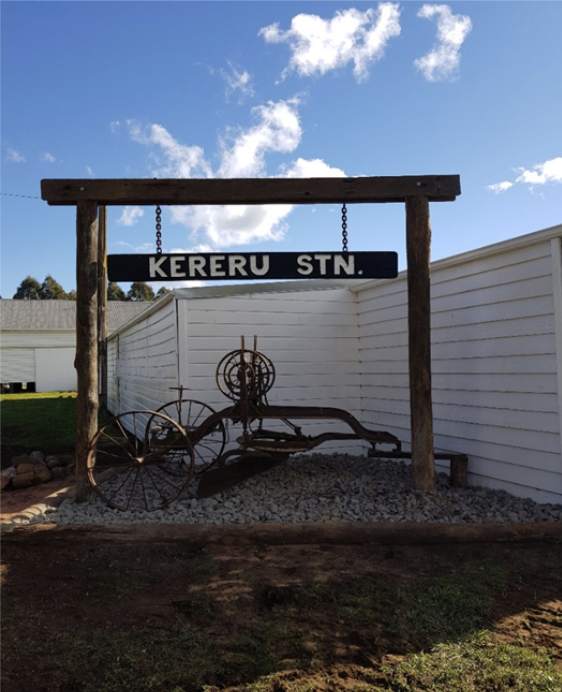
The station is owned by two Trusts which run it as a partnership. Profits are used to support Hawke’s Bay organisations in need, primarily those involved in education. The station employs a general manager, who works alongside a three-person advisory team to deliver the farm strategy. The two blocks are run as separate units, each with its own manager, reporting to the general manager.
The station has an effective area of 1840 hectares and runs 21,500 stock units including 500 ewes, a 200-beef cow breeding herd and its replacements, and 850 Friesian bulls. In addition, more than 20,000 lambs are traded annually.
The property is well-resourced and has a high level of modern, innovative infrastructure for example, automatic sheep weighing and drafting and new sheep yards.
The challenge
Kereru Station supports a number of organisations around Hawke’s Bay. After facing both droughts and the “wettest season on record”, the team needed to make their farming systems more flexible and resilient so the organisations that rely on them could be certain of continued funding.
The results
On-farm progress
• Methane reduced by 17%
• Nitrous oxide reduced by 24%
• Buying in stock to finish quickly gives the farm flexibility
• Finishing home-bred stock instead of selling as stores
• Majority feed intake goes to live weight gain rather than stock maintenance
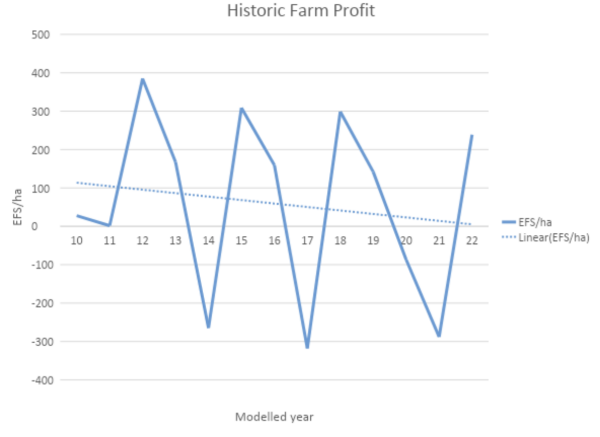
The farm has been in the epicentre of a series of droughts in the Hawke’s Bay. This caused large fluctuations in farm financial surpluses, which not only took time to recover from, but also meant the charitable organisations dependent on donations from Kereru were unable to operate with any certainty. The key motivation for change therefore was to develop a more financially sustainable operation, which also resulted in reductions in GHG emissions.
Table 1: Changes in production
|
|
2010 |
2012 |
2014 |
2016 |
2018 |
2020† |
2022 |
|
Effective area (ha) |
945 |
945 |
945 |
945 |
911 |
911 |
911 |
|
Total eaten (t DM grazed per ha) |
8.02 |
8.26 |
8.16 |
8.61 |
8.86 |
8.11 |
8.43 |
|
RSU/ grazed ha |
14.6 |
15 |
14.8 |
15.7 |
16.1 |
14.8 |
15.3 |
|
Feed conversion (kg DM/ kg prod) |
24.9 |
21.7 |
23.6 |
26.6 |
23.3 |
29.1 |
22.5 |
|
Kg meat and wool / grazed ha |
322 |
380 |
345 |
324 |
379 |
279 |
375 |
|
Gross margin ($/ha) * |
$1,126 |
$1,623 |
$839 |
$1,334 |
$1,472 |
$1,043 |
$1,675 |
|
EFS/ha* |
$28 |
$385 |
-$265 |
$159 |
$299 |
-$87 |
$239 |
* expressed in 2023 dollars. † a drought year where supplements were fed
The declining and volatile farm profitability at Kereru Station between 2010 and 2022 is shown in Figure 1.
Figure 1: Profitability of Kereru Station 2010-2022
Since 2021 the farm has shifted from running a significant amount of breeding stock, where the maintenance percentage of their annual feed intake is high, to a trading and finishing system. The latter is a more flexible livestock policy where the buying and selling options are greater. This allows feed demand and supply to be better matched. It is a more efficient model where the majority feed intake results in live weight gain which in turn has led to GHG emissions efficiency gains.
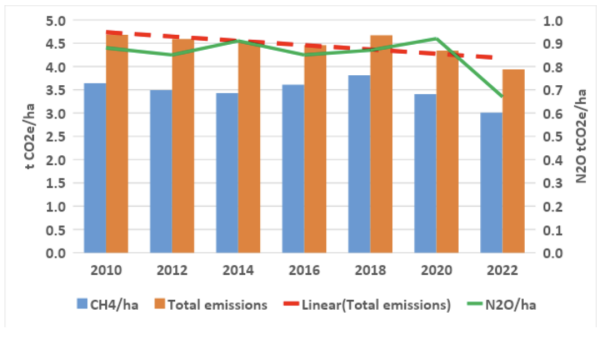
There has been a 17 percent reduction in biological GHG emissions per effective hectare between 2010 and 2022 (Table 2).
Table 2: GHG emissions
|
|
2010 |
2012 |
2014 |
2016 |
2018 |
2020 |
2022 |
% Change 2022 vs 2010 |
|
Methane t CO₂e/ total ha |
3.64 |
3.49 |
3.43 |
3.61 |
3.81 |
3.41 |
3.01 |
-17% |
|
Methane t CH₄/ total ha |
0.15 |
0.14 |
0.14 |
0.14 |
0.15 |
0.14 |
0.12 |
-17% |
|
Nitrous oxide t CO₂e/ total ha |
0.88 |
0.85 |
0.91 |
0.85 |
0.87 |
0.92 |
0.67 |
-24% |
|
Total biological t CO₂e/ effective ha |
4.68 |
4.59 |
4.54 |
4.46 |
4.67 |
4.34 |
3.94 |
-17% |
|
Total biological t CO₂e/ total ha |
4.52 |
4.34 |
4.34 |
4.46 |
4.67 |
4.34 |
3.68 |
-19% |
|
Total biological t CO₂e/ kg product |
16.2 |
14.0 |
15.6 |
17.1 |
14.9 |
19.1 |
14.0 |
-14% |
Figure 2: Changes and trends in GHG emissions
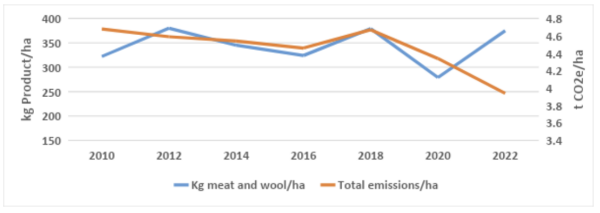
Production of meat and wool per hectare has increased whilst greenhouse gas emissions have decreased (Figure 3).
Figure 3: Production and greenhouse gas emissions per hectare
What changed on-farm
In 2021, a full strategic plan was developed, incorporating the Trusts’ visions for the future of the property.
Business discussions and decisions are based around four key pillars within the plan – people, planet, progress and profit. The four pillars are seen as vital, and they seek a balance to deliver them all. While the emphasis to date has been on improving financial resilience, the planet pillar also includes a conscious drive to reduce the station’s greenhouse gas emissions.
Decisions were made to increase the farms’ resilience to climate change. This has led to having more flexible stock policies that can respond quickly to the unpredictability of the climate.
Planning for more change
A new dam that holds 650,000 m³ of water, providing up to 340 mm/ha/year of pivot irrigation to 200 hectares of flats has recently been completed. This will decrease pasture and crop production variability and help deliver consistent and reliable financial returns.
In the future, the owners of Kereru Station will continue their appraisal of appropriate land use across the whole farm, including forestry and land retirement options on some low performing hill country.
The main driver in being climate resilient is for steady financials, and the Trust continues to investigate how it would like to see the landscape in 50 to 100 years and beyond. They are undertaking long-term modelling to determine the value of the breeding unit to the overall operation and how alternative land uses, such as production forestry and indigenous plantings, could benefit the trustee vision and goals. This is constrained around continuing to be able to provide the Trust the financial returns that are required by the Trusts’ benefactors. Key focus areas are continued monitoring, investigation of options and people development.
Farming for resilience
The Kereru team implemented a number of policies designed to build reliable profits and resilience. Their actions include:
- Shifting from running breeding stock only to a trading and finishing system
- New dam supplies irrigation system which underpins the whole finishing operation
- Collect farm performance data
- Use decision support tools to review farm management
- Understand appropriate land use options, including the possibility of forestry and land retirement
Lessons for other farmers
“Farmers need to take time to look at the farming operation at a distance rather than always being fully immersed in day-to-day operational requirements.”
Below are some suggestions from the Kereru team to help other farmers get their heads around the opportunities and challenges in reducing agricultural greenhouse gas emissions and adapting to a changing climate:
- Ongoing collection of farm performance data enables continuous monitoring and management decisions to be made rapidly and with confidence.
- The use of decision support tools to aid in monitoring, decision making, and the reviewing process is vital.
- Continuously look for new options and don't be frightened to seek outside help to guide thinking through an analytical process.
- Farmers need to view themselves as land managers who farm according to their long-term vision. To do this, farmers need to take time to look at the farming operation at a distance rather than always being fully immersed in day-to-day operational requirements.
What actions could work on your farm?
Many of the changes made at Kereru Station are actions other farmers are already exploring around New Zealand. Discover what could work on your farm:
Published: June 12, 2026