
 Emissions calculator


The long game: Farming for future generations
Taking a long-term approach to farming, the five iwi behind Pouarua Farms have reshaped the farm system to better reflect the needs of the whenua, future generations and the realities of farming on peat soils.
On-farm successes:
• 14% reduction in greenhouse gas emissions since 2018
• Up to 100% increase in profitability in some blocks
• 350 fewer cows with improved per-cow production
• Diversified into blueberries, dairy beef and cropping
"We have to make sure it is here for future generations, which means working out what the best thing for the land is."
Chief Executive Jenna Smith
Watch this story
About Pouarua
Pouarua Farms is jointly owned by Ngāti Maru, Ngāti Paoa, Ngāti Tamaterā, Ngāti Tara Tokanui and Te Patukirikiri. Jenna Smith is Chief Executive. The farms are located on the Hauraki Plains, just southwest of Ngatea within the whenua Māori blocks known as Ngarua, Waitakaruru and Puhangateuru.
In 2018, operation of the land was fully undertaken by its Iwi owners. At that time, the whole property was in dairy. Now, the whenua comprises eight dairy farms, a dairy beef unit, various cropping (maize) blocks, and a horticultural unit growing blueberries.
"The whenua is a taonga to its owners. It will never be sold again," says Chief Executive Jenna Smith. "We have to make sure it is here for future generations, which means working out what the best thing for the land is."
As for the herd, there is one split calving and one autumn calving block. The remainder are spring calving. The herds are a mix of straight jersey A2 and cross-bred A2 with the cross-bred herds moving to A2 jerseys in the near future.
The table below shows the enterprise mix.
Table 1: Land use at Pouarua
| Enterprise | Land area (ha) |
| Dairy | 1,775 |
| Cropping | 225 |
| Horticulture | 10 |
| Dairy-Beef | 200 |
| Wetland | 10 |
| Retired land | 23 |
| Non-productive (races, drains etc) | 7 |
| Total | 2,250 |
The challenge
The Hauraki Plains are highly productive dairy country, but farming peat soils comes with challenges. The land is vulnerable to drying out during summer, subsidence over time and environmental pressures linked to intensive farming.
For Pouarua, the challenge wasn’t simply reducing emissions. It was building a farm system that better matched the land itself — while remaining profitable and resilient for future generations.
The results
On-farm progress
• 14% reduction in biological greenhouse gas emissions since 2018
• Emissions intensity reduced from 9.1 to 7.9 kg CO2e/kg MS
• Up to 100% increase in profitability on some blocks
• Improved biodiversity through retired land and riparian planting
Biological greenhouse gas emissions across all Pouarua Farms have decreased by 14% since the five Iwi took over full operation in 2018, as shown in the table below.
Table 2: Pouarua greenhouse gas emissions 2018-2022
| 2018 | 2019 | 2020 | 2021 | 2022 | |
| Methane (total T CO2e) | 10,095 | 10,443 | 12,235 | 11,818 | 9,676 |
| Nitrous oxide (total T CO2e) | 3,227 | 2,863 | 3,081 | 3,212 | 2,489 |
| Total tonnes CO2e | 14,803 | 13,168 | 14,041 | 14,698 | 12,760 |
There have been some fluctuations in the numbers over the years, related to the level of production achieved. For example, the 2021 emissions climbed on the back of increased cow numbers and a very good production year, as shown in Table 3.
Table 3: Cow numbers and production
| Cows | kg MS | kg MS/cow | |
| 2018 | 4,851 | 1,431,202 | 295 |
| 2019 | 4,623 | 1,446,694 | 313 |
| 2020 | 4,595 | 1,539,676 | 335 |
| 2021 | 4,743 | 1,658,866 | 350 |
| 2022 | 4,311 | 1,440,226 | 334 |
Within the individual farms, most have shown a reduction in emissions since 2018. The two farms that showed the largest decreases (45% and 39% respectively) achieved this largely by reductions in farm area and diversification into other land uses e.g. cropping or retirement. Average emissions per hectare have decreased, as has the emissions intensity (emissions per kg of milk solids).
This is shown in Table 4.
Table 4: Total emissions and emissions intensity numbers for Pouarua since 2018.
| Emissions/ha (T CO2e/ha) | Emissions intensity (kg CO2e/kg MS) | |
| 2018 | 7.5 | 9.1 |
| 2019 | 6.6 | 9.0 |
| 2020 | 7.1 | 8.8 |
| 2021 | 8.3 | 8.8 |
| 2022 | 7.2 | 7.9 |
OverseerFM was used to model the farms' greenhouse gas numbers shown in this case study. To find out more about this tool and others, see our Know Your Numbers page.
What changed on-farm
Since 2018, a number of changes have been made that have led to a reduction in greenhouse gas emissions. These changes were not made on all blocks, but were applied where the land use decisions made sense. These include:
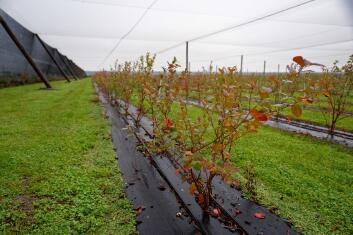
Blueberries under the canopy at Pouarua. (Photo: Dave Allen Photography)
- Reduced cow numbers (350 total) and improved per cow production (increased by 39 kgMS/cow).
- Increased the area of maize cropping (for internal use and for sale).
- Removed 200ha from one block's dairy platform to develop a dairy-beef block.
- Retired unproductive dairy area to develop a 10ha blueberry unit.
- Moved one herd to once-a-day (OAD) milking.
In addition to the resulting reduction in emissions, Pouarua are seeing increased profitability and better cow condition, which in turn is improving reproductive performance. The shift to OAD milking on one of the blocks has reduced time for cows and staff in sheds, leading to happier, less stressed staff. The areas that have been retired have native vegetation and bird life coming back, improving biodiversity.
Next steps
Explore practical actions farmers are trialling on farm.
What led to the changes?
Pouarua are focused on ensuring that the land is used in a way that provides long-term sustainability for the whenua and its people. The changes made reflect this mindset, making sure that land use is appropriate for the available land and water resources.
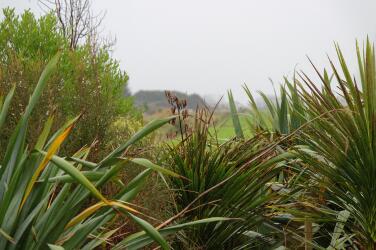
Riparian planting at Pouarua. (Photo: Dave Allen Photography)
Some changes were also made proactively to support outcomes and respond to the farm’s proximity to important wetland ecosystems. Other changes were driven by a need to improve profitability and labour efficiency, e.g. reduced walking time for cows, reduced inputs, feeding animals better to improve performance.
Pouarua has further plans for continuing to refine how the whenua is farmed, for example doubling the area of blueberries under canopy.
Farming for resilience
Pouarua is continuing to refine the farm system to support long-term resilience while responding to changing environmental and market expectations. Actions helping build resilience include:
- Continually assessing land use in relation to inherent characteristics of the land and water resources, alongside market and regulatory drivers.
- Riparian areas are retired and planted with natives.
- Other retired areas are regenerating into native vegetation.
- All pasture and summer brassica are direct-drilled.
- Diverse pasture species are used, e.g. chicory, fescues, plantain etc.
Lessons for other farmers
“Consider what happens to your product beyond the farm gate... you need to understand the market you supply to and the responsibilities that come with that.”
Chief Executive Jenna Smith
Below are some suggestions from the Pouarua team to help other farmers get their heads around the opportunities and challenges in reducing agricultural greenhouse gas emissions and adapting to a changing climate:
- Rather than continuing to farm the land the same as always, reflect on what is right for the land and your values as a farmer to help determine if your land use is appropriate. If it doesn't feel right, it probably isn't.
- If you are looking at changes, and trying to make the numbers work, don't be afraid to bring in some outside advice or support to provide a different perspective.
- Consider what happens to your product beyond the farm gate. Don't just farm the animals on your land, you need to understand the market you supply to and the responsibilities that come with that.
- Don't let uncertainty stop you. Focus on what you can do and what you can control.
"We shouldn't be afraid that our customers are expecting this from us," says Jenna. "And we shouldn't be afraid that we're not already doing it."
What actions could work on your farm?
Many of the changes made at Pouarua are actions other farmers are already exploring around New Zealand. Discover what could work on your farm:
Download this story
Download a copy of the Pouarua Farms story here [PDF, 731 KB] .