
 Emissions calculator


Diversifying for Better Performance and Fewer Emissions
By planting mānuka to produce honey, retiring and replanting unproductive land and optimising their farming systems, the Tripe family is reshaping Oxton Farm for long-term sustainability, both environmental and financial.
On-farm successes
• 245ha in mānuka provides revenue from honey
• Modelled to produce 54% decrease in net emissions
• Genetic changes increasing productivity while reducing capital stock
Watch this story
"A significant portion of our revenue comes from honey. Just as importantly, there's an opportunity to generate carbon credits from that planting."
Johnny Tripe
About Oxton
Over 60 years of farming, Nick Tripe has established a 1,325 hectare (936ha effective pasture and 245ha productive mānuka) hill country property located between Whanganui and Hunterville. The property is rich in history, with the family farming the original block in 1928, and has grown over time to the enterprise it is today.
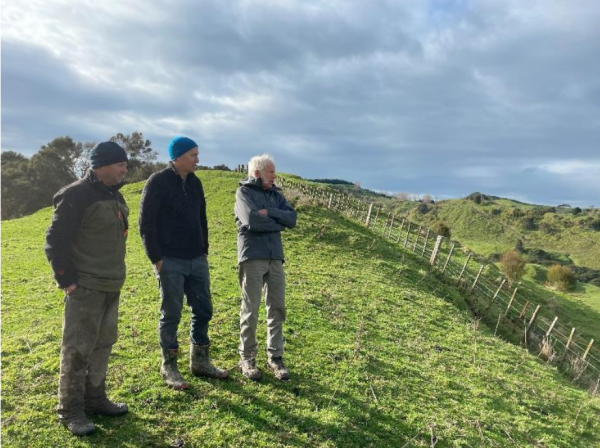
Nick oversaw a farm succession process which culminated in ownership of the farm being transferred to his son Johnny and daughter-in-law Emmeline in 2023.
The property is predominantly medium to steep hill country with smaller areas of finishing land. The farm system is based around 4,500 Romney/Coopworth breeding ewes, replacements, and selling progeny. Two-hundred angus cows are run on the farm, with surplus progeny sold as two-year olds. Additional income comes from a mānuka honey profit share arrangement with a honey producer.
The tables below show the enterprise mix and capital stock numbers.
Table 1: Oxton land area (ha)
| Enterprise |
Land area (ha) |
| Sheep and beef | 936 |
| Mānuka | 245 |
| Retired native forest | 120 |
| Non-productive (races, drains) etc | 24 |
| Total |
1,325 |
Table 2: Capital stock numbers and production
| 2021 | 2023 | Future | |
| Effective ha | 1084 | 1012 | 936 |
| Breeding ewes | 4370 | 4443 | 4064 |
| Breeding cows | 170 | 200 | 160 |
| Total SU | 9254 | 9036 | 8432 |
| SU/ha | 8.5 | 8.9 | 9.0 |
| Net production (kg/eff ha) | 132 | 160 | 194 |
The challenge: Building a farm system fit for the land
Oxton Farm, on hill country near Whanganui, includes stewardship of a local river and land special to local iwi. For the Tripe family, the challenge isn’t only about reducing emissions, it’s about sustaining the land and building profitable, sustainable systems for their farm community and future generations.
The results
On-farm progress
• 245ha in mānuka, both planted and already in gullies
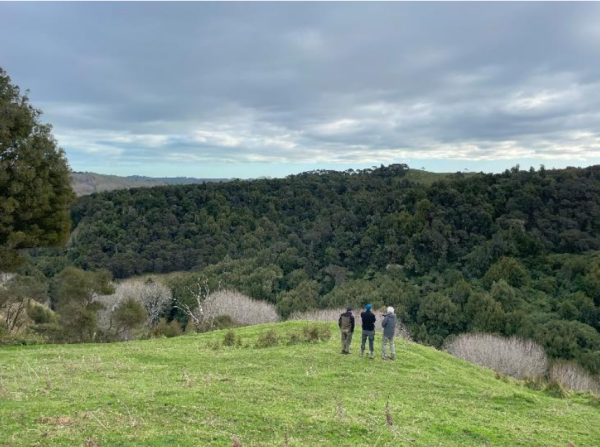
• 120ha of retired native forest registered in Emissions Trading Scheme
• Total future biological emissions projected to reduce by 4%
• Net emissions reduced by 54%
The farm was modelled in Farmax for the three years being analysed. To find out more about this tool and others, see our understand your emissions profile page.
Figure 1: Gross versus net biological emissions (methane and nitrous oxide) across the whole farm.
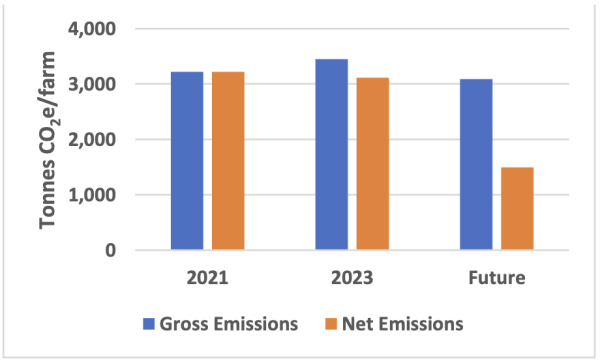
There have been some fluctuations in the numbers over the years, related to the level of production achieved. For example, the 2021 emissions climbed on the back of increased cow numbers and a very good production year, as shown in Table 3.
Table 3: Oxton GHG profile
|
2021 |
2023 |
Future |
% Change future vs 2021 |
|
|
Total biological emissions (T CO2e/farm) |
3219 | 3451 | 3089 | -4% |
|
Methane (T CO2e/ha) |
2.43 | 2.78 | 2.69 | 11% |
|
Methane (kg CH4/ha) |
97 | 111 | 108 |
11% |
|
Nitrous oxide (T CO2e/ha) |
0.54 | 0.63 | 0.61 | 13% |
|
Sequestration (T CO2e/farm) |
0 | 338 | 1593 | |
|
Net emissions (T CO2e/farm) |
3219 | 3113 | 1496 | -54% |
As shown above in Table 3, emissions per hectare have increased due to the higher stocking rate on the better land, although the expectation is that gross biological emissions will reduce (by 4 percent) due to the lower total stock numbers.
The net GHG emissions reduction is due to the change of land use on the poorer classes of land. Note that while the forest is registered in the ETS, in order to claim carbon credits, these credits cannot be sold if the farm is claiming them as an offset.
The planting of 245 hectares of mānuka is modelled to sequester 1,593T CO²e/yr in the future, decreasing net emissions (gross emissions from the farm, less carbon sequestered by the forest) to 1,496T CO²e/yr, which is a 54 percent decrease in net emissions since 2021.
The emissions profile and environmental footprint has been at the forefront of the strategy for Oxton Farm. It is rewarding for the Tripes to be making inroads in offsetting their emissions while also maximising the productive capacity of their asset. This is proving to be a more financially viable and complete business model for the family.
What changed on-farm
The Tripes have utilised the changes below to improve their on-farm GHG footprint.
- Farmax modelling for systems optimisation.
- Identify alternative land use strategies and the retirement of non-productive areas.
- Introduce genetics changes to increase fecundity and survival.
- Introduce variable rate fertiliser application to match fertiliser inputs with requirements.
- Carbon sequestration mapping to identify areas eligible for the ETS.
The family sees further opportunity to identify existing scrub on marginal land which could be left to regenerate to ETS eligible size, extending their carbon sequestration profile.
Areas outside ETS eligibility and low erosion risk areas will be maintained for productive livestock farming. Stocking rate is at an optimal level to work alongside the natural resource of the farm. Increased improvement in reproduction and liveweight gain of stock is a continued goal, with low emissions genetics being explored when commercially viable.
Next steps
Explore practical actions farmers are trialling on farm.
What led to the changes?
Emissions reduction and financial gain are equally essential factors when developing system changes to enable the farm to play a long-term role in reducing greenhouse gas emissions. To date these changes have had substantial offsetting benefits while creating a diverse and profitable business, enabling developments to occur at scale.
The land class and climate of Oxton Farm present challenges and limit production, meaning continued research will be essential to uncover further opportunities.
Farming for resilience
Oxton has a number of strategies in place to support long-term resilience while responding to changing environmental and market expectations. Actions helping build resilience include:
- Removing livestock from the most erodible/low performing pastoral land where biological emissions are high in relation to livestock production.
- Increasing the efficiency of remaining livestock through body condition scoring, non-negotiable targets for young stock and better utilisation of grazed pastures.
- Marketing store stock earlier to reduce the amount of maintenance feeding.
- Variable rate fertiliser application to match input with requirements.
- Integration of scrub in erosion vulnerable areas (to be included in the ETS).
- Retiring of native and wetland areas.
- Create a collaborative and inclusive approach especially when working towards an improved wider area such as a river catchment.
- Being open minded to all options available and the range of benefits they can provide.
Lessons for other farmers
“Farming is a constantly evolving space and you've got to be focused on understanding the macro environment within which you operate and respond accordingly.”
Johnny Tripe
Below are Johnny’s suggestions to help other farmers get their heads around the opportunities and challenges in reducing agricultural greenhouse gas emissions and adapting to a changing climate:
- Create a team of people with different areas of expertise to add valuable advice and support throughout the process.
- Use tools available to you to analyse changing scenarios and make calculated decisions. Tools such as Farmax modelling and digital mapping software have helped significantly in Oxton’s system development.
- Utilise regional councils or other support services to help with knowledge sharing and funding options.
- Include the local community and iwi where possible.
What led to the changes?
Emissions reduction and financial gain are equally essential factors when developing system changes to enable the farm to play a long-term role in reducing greenhouse gas emissions. To date these changes have had substantial offsetting benefits while creating a diverse and profitable business, enabling developments to occur at scale.
The land class and climate of Oxton Farm present challenges and limit production, meaning continued research will be essential to uncover further opportunities.
The incentive for emissions reductions and other environmental investment is the satisfaction of the owners and wider family. While the Tripes endeavour to optimise productivity and profitability, they are aware of the need to reduce the environmental footprint of the farming operation.
They strive to enhance profitability from alternative land use and embrace greenhouse gas mitigation technology in the livestock system. The Tripes expect that environmental assurance certifications will reward the business with a market premium for its product.
Measures to optimise productivity will allow for production levels to be maintained, with a smaller number of animals and land area, and mānuka planting offsetting the increase in GHG emissions.
What actions could work on your farm?
Many of the changes made at Oxton Farm are actions other farmers are already exploring around New Zealand. Discover what could work on your farm:
Download this story
Download a copy of the Oxton Farms story here [PDF, 924 KB]
Published: June 12, 2026